Boom Generation Fitness

Mind - body fitness and health strategies for powering thru later years

The blog is aimed at the generation that was born between 1946 and 1964 - the so-called Baby Boomers.

We are now into our middle-age and very interested in staying fit and healthy until well into our senior years.

This blog provides some of the tools to do just that. You can find posts here and lots more by clicking on the links to THINK FIT and THE FITNESS PAPERS (see left side column).

These pages are about any and all matters concerning wellness, mind, body and spirit and, of course, physical exercise of all sorts. A special feature is an emphasis on individuals who can provide examples for us all of a healthy, energetic and positive life.

............WELCOME!

Geoff Quartermaine Bastin

More about who I am on:
http://www.visualcv.com/users/185930-fitnessman/cvs/223748

Saturday, April 05, 2008

HIGH INTENSITY WEIGHTS - THE MIKE MENTZER WAY

In 1978, Mentzer won the amateur Mr. Universe contest with the first and only perfect score. In late 1979, he won the heavyweight class of the apex Mr. Olympia contest (open only to champion professionals) again with a perfect score. Mentzer retired from competitive bodybuilding after the 1980 Olympia show at the age of 29 when most people agreed he should have beaten Schwarzenegger. He died unfortunately in 2001 due to an undiscovered genetic blood disorder unrelated to his body building activity. He remains a huge influence for more intelligent body-builders who want a scientific, logical and proven way to develop without drugs. For more info the link is:

http://en.wikipedia.org/wiki/Mike_Mentzer

Mentzer devised and successfully implemented his own theory of bodybuilding. His theories are intended to help a person achieve their full genetic potential within the shortest amount of time without the use of harmful steroids.

The essence of the system is as follows: maintain perfectly strict exercise form, move the weights in a slow and controlled manner (about 6-8 seconds per full rep), work the muscles to complete failure (positive and negative), and avoid over-training – allow time for the body to recover and grow.

What does this mean in practice? Leave aside the question of what exercises to choose and how to do them (form): we can discuss these aspects later (this is a huge subject, by the way, which makes it so interesting – each session becomes a scientific experiment! I would never have suspected that body-building was an intellectual activity!). In simple terms, stick to the basic, simple exercises and learn how to do them precisely and perfectly ….Lots of websites for doing that which I will return to exercises and form in another article. For now, remember whatever exercise you do, choose a weight where you can do the exercise in perfect form without “cheating” (i.e., using body weight, momentum or muscles other than the target group to lift the weight).

Now: the scientific principle of the Mentzer Method or Way is that muscles build size and strength in direct proportion to the amount of absolute weight they move at one time, not the length of time they move that weight over. This is why (for example) people’s legs get to a size relative to the weight of their body, but don’t get very much larger even if they walk or run or cycle extensively – the muscles increase in stamina relative to the duration of use (i.e., the person can shift the given weight for longer periods of time – which is what you train for in cycling or running), but not significantly in strength or size (although obviously an exercised limb will have more muscle than one that is not used at all).

So, the muscle will grow relative to the heaviest weight, the maximum weight that it has had to move once. The most a muscle can grow is thus related to the weight where the muscle simply cannot move it more than once. This is what is meant by training to “failure”. Put another way: if I can just bicep curl once with 25 pounds, then the bicep will allocate exactly the necessary fibres to lift 25 pounds once, no more, no less. If I want more fibres (bigger muscle) then I have to lift a heavier weight. There is no other way of growing muscle.

Let’s take a simple example: a dumb bell curl to impact the biceps. You can curl 10 reps per set with (say) 20 pounds. After a 1 minute rest, you curl the same weight for another 10 reps (another set). You do another set and another. By now your biceps are tired. By repeated training with the same weight you will increase the number of sets you are able to do. You have increased the muscle’s stamina (ability to repeat the movement), but you have not trained to failure and you have not increased in absolute strength (i.e., you won’t be able to lift much more than 25 pounds). And you may have spent 15 minutes or 20 minutes doing the sets. The next time in the gym, you repeat the sets…. And you may do this every day of the week. Your entire time can be spent in the gym – with no gain in size and strength. Indeed, over-training a muscle (i.e., not allowing it time to rest, recover and grow) can lead to injury and muscle loss – the opposite of what you are investing time and energy to achieve. This is the most common experience of people who go to the gym; disappointment sets in, they get injured and they stop training.

This time-based, high set number approach WILL NOT grow your bicep or add to your strength. I know, I tried it for years and wondered why the hours I spent in the gym and the hundreds of sets added absolutely nothing to my size or strength.

Using intensity training, the approach is different: by experiment, you find that you can just do 6 reps with a 25 pound weight. On the 6th rep, your bicep “fails”, i.e., you cannot manage to repeat the exercise. You wait one minute, and repeat, this time you just manage 5 reps before the muscle fails. You stop. You are at your absolute physical limit.

Now, your muscle has found a new weight limit. It has been severely stressed and needs serious time to recover. You do not repeat the exercise for one week. Recovery time is the other part of the intensity equation; muscles do NOT grow in the gym, they grow when they are recovering. You MUST leave enough time for recovery and growth. By the way, the bigger the muscle, the heavier the weight, the more stress and the longer time to recover…. I train my legs to failure with a (current) max 500 pound leg press only once a month, my back to failure (currently) with a 198 pound lat pull down once every 2 weeks and biceps once a week with (again currently) about 88 pounds. For these exercises I do 2 sets of 10 reps on the legs, 3 sets of 6 reps on the back and 3 sets of 10 reps on the arms.

The next time in the gym, do NOT simply repeat the 25 pound/6 rep/2 set exercise. Increase the weight by a small amount. You will find that you can just do the 6 reps with a heavier weight – your muscle has got stronger, and you will also see that it has grown. By small incremental steps in the absolute weight used, you will fairly quickly see increase in size and strength. And you will not be spending so much time in the gym – better results for less time spent.

A note on weight and age: there is a trade-off obviously. A young stud of 25 can half kill himself (indeed herself) lifting a real maximum weight and collapse at the end with failure….. Your average 50-year-old is asking for trouble doing that. As weights increase (and your strength with them) so the pressure on joints, bones and the arterial system increases. You can get to the point where your muscular strength simply outstrips the capacity of the support systems. So I am very careful to understand where my absolute max probably is – you can find out by cautious experiment – and then I back off slightly, substituting an even greater emphasis on form and slow speed for the top weight theoretically possible. I also stop as soon as I feel nauseous or in any way light-headed. In this way I have never been injured. As ever – consult a doctor if you haven’t used this intensity training approach before.

The guts of the approach then, is to use as heavy a weight as you safely can for 6-8 reps per set. Try another set to failure. Go slow (6-8 seconds per rep). You will find that the slower you go, the less weight you can lift (so again, you can substitute slow reps for heavy weights to protect yourself). If you can do more than 3 sets with the weight at your chosen rep speed, then it is not heavy enough. Rest and recover for about a week (Mentzer used to recover over a fortnight!), next time increase the weight for the same number of reps/sets.

It is essential to understand that moving the same weight for more reps and more sets is NOT increasing your strength or size, it is increasing your stamina (and you may want that). If you want to grow, the ONLY way is to increase the absolute weight for a fixed duration and allow longer recovery periods as the weight is increased (since the stress on the body also increases).

The results will be dramatic. You will see visible results in the mirror each week, In a month you will go from e.g. 25 pound bicep curls to 40 pounds – a measurable increase in strength. You will have spent less time in the gym (important as you get older and more prone to injury) and generally feel better because you are not constantly exhausted. Seeing is believing……. I have been AMAZED that at 58 I can grow in size and strength in a way I could never do before. No injuries, no tricks and a minimum of time pumping iron.


Monday, February 11, 2008

EDDIE WINS!

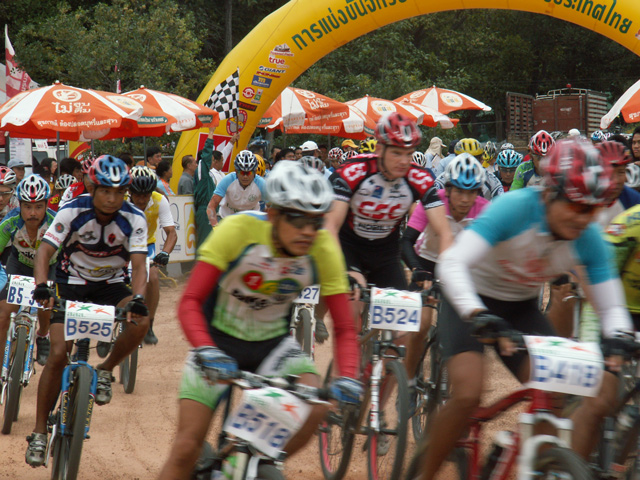
Eddie Vernon writes from Thailand: On 26 January went to Chiang Rai to compete in the first of the 5 race series for the national mountain bike championship and came first in the 50+ age group (as I expected). See picture attached. The guy second from right came third. He won all 5 races in 2007. The guy who came second (second from the left) moved up with me into this age group this year - I competed directly with him twice last year and was faster than him both times. So as long as I stay fitter than the others I am confident I'll win the series and subsequently receive a trophy from the prince some time next year.

Saturday, February 09, 2008

POMEGRANATE JUICE - NOT SUCH A SIMPLE CURE

My good friend and supplements guru gave me a heads up about pomegranate juice. He’s just experienced some issues with prostate cancer and orders the juice every time we dine together. According to Wikipedia, “Studies indicate that pomegranate juice reduces arterial plaque, reduces systolic blood pressure, and reduces LDL cholesterol” One 250 ml (8.45 oz) glass of pomegranate juice provides approximately 50% of an adult's recommended daily allowance (RDA) of the vitamins A, C and E. Pomegranate juice provides 100% RDA of folic acid and a substantial amount of potassium and niacin. Wiki also gives the scientific journal references that support the claims for help with prostate cancer. http://en.wikipedia.org/wiki/Pomegranate_juice

But be warned: there is also evidence that with some medications the juice can be dangerous. A 48-year-old man was taking ezetimibe (trade name Zetia) 10 mg a day and rosuvastatin (trade name Crestor) 5 mg every other day for 17 months. Both medications are used to treat high cholesterol. He began drinking pomegranate juice (200 ml twice weekly) and three weeks later, was admitted to emergency with thigh pain and an elevated serum creatine kinase level. Both are symptoms of rhabdomyolysis, a serious condition that causes the breakdown of muscle fibers and may lead to kidney failure. Rosuvastatin belongs to a group of medicines called HMG-CoA reductase inhibitors, or ‘statins’. Grapefruit juice is known to increase the risk of statin-induced myopathy, but up until now, there was little information about whether pomegranate juice might also increase the risk. Pomegranate juice and grapefuit juice, are both known to block enzyme systems in the intestines. By inhibiting these enzymes, the juices may increase blood levels of many medications.

For more information on drug interactions look at http://altmedicine.about.com/od/druginteractions/a/pom_interaction.html

Bottom line: nothing is free. Before you take the magic cure, make sure you read what there is on the Net and when in doubt, ask the doctor.

Thursday, January 03, 2008

EXECUTIVE STRESS

George Anderson, an anger management and executive coach for physicians asked the following question on LinkedIn (by the way, join http://www.linkedin.com/ as a major business network and see George's profile):

"Are the stresses in your life impacting your success?
Stress is a primary emotion which is a factor in many diseases including heart attacks, strokes, ulcers, diabetes,hypertension, depression and anxiety. Stress precedes anger and exacerbates frustration and anger. Stress reduces the ability to concentrate and focus on precision learning"


The answer is almost certainly yes if you are a senior executive from the BB Generation. What's important about this (aside from the obvious health aspects) is that senior executives hold the knowledge base for their companies. Given that increasingly knowledge is seen as a corporate asset, anything that impacts on this important resource such as stress-induced ill health or poor performance directly diminishes corporate wealth.

This is a subject that Boom Generation Fitness will be investigating. Watch this space!!

PS: the photo just illustrates the kind of pressure at work Baby Boomer executives are subject to.... not always lunching or playing golf!!

Monday, December 10, 2007

Fitness Tracking


This looks like a potentially interesting site. I was looking at the BBC World programme "Click" and saw a feature by Kate Russell. Here's what she says (thanks for the quote Kate and BBC):

"Gyminee is a fitness and workout tracking site, which allows users to keep a strict eye on their fitness regime.

The site makes use of a couple of visual interfaces, which report back on the effectiveness of your training regime via a number of graphs and diagrams.

The site is still in beta stage but is accepting free testers. It is necessary to enter some login details to join, but once this is complete you are presented with your own profile page, which is reminiscent of a social networking site.

Enter your objectives, from weight loss to muscle growth and the site creates tracking tools appropriate to your goals.

For example, clicking on the locker room tab provides a graph which tracks the user's progress depending on the data added after a workout.
For info on the sort of training regime that might suit you, the workout section contains a library of different programs. Some of these have frightening titles like Killer Abs - but you know what they say? No pain, no gain.

A nice touch is that some workout programs include instructional videos.
Users can also keep a track of their diet via the nutrition tab, and there is an element of social networking in the gym buddies option. This allows users to try and find workout buddies both real and virtual via the forums
."

The Gyminee "About" blurb says: " Gyminee Corporation was founded in 2007 to meet a targeted need in the health and fitness market. While a few other fitness tracking web applications exist on the Internet, none adequately capture the need for real fitness tracking using a simple interface."

I've signed up and we'll see how useful it is... I keep most of my exercise tracks in notebooks and excel spreadsheets...so maybe this will keep things in one place.. Check out www.gyminee.com

Monday, December 03, 2007

THE ICEMAN COMETH

Eddie Vernon writes from Thailand: On 17 November I competed in the last of a series of five national races for 2007. I came 4th in the race (40 - 49 year olds) and 5th in the series (though I only competed in 2 out of 5 races). The photo of me leaving the start line (I'm the guy in the centre in red, black and white).

One of my motivators is Ned Overend, who is a legendary mountain biker. At 52 years of age, he just landed a sixth place finish in the Iceman Cometh race (with over 2,000 competitors) in which he was racing against top professionals half his age. The Iceman Cometh is a 43.5km (27mile) point-to-point classic in northern lower Michigan.


Ned hit the top at the age of 32 when he won two world mountain bike championships in August 1987; one in France and the other in Mammoth, CA. He won the world cross-country in 1988, and NORBA national champion titles in 1986 and 1989. Ned is known for his uphill climbing ability, both as a mountain biker and a road biker --- which he does to get in shape for mountain biking. He has frequently dominated the Iron Horse Classic in Durango. Although he retired in 1996 at the age of 41, he immediately joined the fledgling XTERRA off-road triathlon circuit and took a couple of their World Championships. I have Ned Overend's book "Mountain Bike Like a Champion" which shares his riding tips and techniques:
http://www.amazon.com/Mountain-Bike-Like-Champion-Overend/dp/1579540813 (Check out Eddie Vernon by clicking on the topic in the right column)

Monday, November 26, 2007

A NEW SUPER FRUIT TO TACKLE CANCER?

Sea Buckthorn is a thorny shrub known to the Romans who fed the protein-rich leaves to horses and to the Chinese who have used it medicinally for 12 centuries. The sea-buckthorns (Hippophae rhamnoides L.) are deciduous shrubs, often used ornamentally, with beautiful grey leaves, sharp thorns and shiny orange berries. They are found in cool upland locations particularly in the Himalayas, but also in Europe and North America. Sea-buckthorn berries are multi-purposed, edible and nutritious. They are rich in a variety of antioxidant chemicals (vitamins C and E; several carotenoids, including beta-carotene (pro-vitamin A); flavonoids; certain enzymes, and other substances). The claim is that the extract from the seed (once the berry pulp is removed) will tackle prostate and breast cancers. Bioactive oil has also been obtained from the young branches and leaves and has been incorporated into an ointment for treating a wide variety of skin damage,including burns, bedsores, eczema, and radiation injury. A true superfruit, perhaps? We will be researching the subject in the context of work being done in Pakistan by our associated company, FoodWorks www.foodworksasia.blogspot.com

There are a number of source links where you can get more information

http://en.wikipedia.org/wiki/Seabuckthorn
http://seabuckthorn.com/sbtscience.htm
International Centre for Research and Training on Sea Buckthorn, http://www.icrts.org/china.htm


Saturday, November 17, 2007

QUARTERMAINE'S WORLD


This is the launch of Quartermaines's World! I have developed three blogs, Q's World is my personal blog open to close friends and relatives only, FoodWorks (http://www.foodworksasia.blogspot.com/) is my company blog describing my development work in agribusiness and food (including medicinal plants), Boom Generation Fitness is, of course, about health and fitness (mind and body) for the Baby Boom Generation - those over 50. All of this is driven thru the quartermainesworld.com domain via Google Apps and my principal email addresses are now: geoff@quartermainesworld.com (personal), foodworks@quartermainesworld.com (business) and fitness@quartermainesworld.com (pleasure). Please enjoy the blogs and comments are always welcome.

Wednesday, October 31, 2007

YASUHIRO KONISHI – TEACHING KARATE IN HIS 90s

Why is Konishi Sensei (who, after all, died in 1983 aged 90) saluted here? I took this photo in 1982 in Sensei’s dojo in Tokyo. He was still teaching class – kendo and karate – clad in his favorite Hawaiian shirt. I can personally testify that it was impossible to touch him in sparring and he could still throw a big man (I am 6 foot 4) to the ground with scarcely a muscle moved. Konishi trained at his chosen art – both body and mind – his entire life and reaped the rewards.

Yasuhiro Konishi, who was born in 1893 in Takamatsu, Kagawa, Japan, began his martial arts training at age 6 in Muso Ryu Jujitsu. At age 13, while practicing jujitsu, Konishi Sensei began studying kendo as well. In September, 1924, Hironishi Ohtsuka, the founder of the Wado-Ryu style of karate, and Gichin Funakoshi, the founder of mainstream Shotokan karate arrived at Konishi's door. With his help Funakoshi established a karatee club at Keio University (the first university karate club in Japan). Thereafter karate expanded to the world-wide activity it is today with Konishi Sensei playing a central role in its development, eventually founding a unique style embodying the best of karate, jujitsu and aikido – Shindo Jinen Ryu. For more on this unique style of karate and details of Yasuhiro Konishi’s life check the link on the right of this page.

Tuesday, October 30, 2007

Muscle strength in adults ages 40 to 80


As you age you lose muscle. The technical term is “sarcopenia”, the loss of muscle mass that occurs naturally — and inevitably — with age. Sarcopenia loses a fifth of a pound of muscle a year, from ages 25 to 50, and then the rate of loss picks up, subsequently taking up to a pound of muscle a year, a loss a man is unlikely to notice until it's too late.

This is a critical reason for considering resistance (another less painful name for weight) training as you get older. Research into this subject is excellently described in a Special Report called “Fight Age with Muscle” by John Brandt (check out the post on our THINK FIT page and the link to msn's Health and Fitrness site) and provides a powerful set of reasons to get in the gym and start sweating!
PS: The heads up for this post was provided by Eddie Vernon (see FIT PEOPLE)

Monday, October 29, 2007

THE TOUGHEST GUY

This is James Bastin. He's not over 50 (for sure!) but he's going into this blog anyway.

James was hit in the head by a taxi when he was 20 in 2005. He was in a coma and then severe post traumatic amnesia for about nine months. He suffered several brain operations including removal and replacement of his skull. When this photo was taken he still could not talk or see properly. In 2007 James passed his 800 metres swimming test; he runs and works out. This young man literally came back from the dead. He is the toughest (mentally and physically) person I know. If you feel you can't do it, think about James and never give up!

Thursday, October 25, 2007

EDDIE VERNON - CYCLING IN ASIA


Eddie Vernon - by way of introduction Eddie is one of my closest friends and one of the fittest guys around irrespective of age. He runs his own businesses in Thailand and Laos and combines them with a competitive cycling career. Here's his profile:


I'm British, born in England in 1958 but have been living in Thailand since 1990. I've been cycling since I was a small kid. There were just a few years around my mid- to late-20s where I didn't cycle much. I used to cycle just for fun and to get around (e.g. commuting to university and to work). It was a year or two after I turned 40 that I entered into a bike race for the first time in my life. It was a cross country mountain bike race in Thailand. I was lucky to escape a big pile-up less than a kilometer after the start, but it was great fun. I can't remember now what position I finished but I won a cup. Entrants are usually categorized into different age groups (of 5 or 10 years spread) so that we're all competing against people of similar age.

Since that first race I have been racing whenever I have a chance. Generally I race in Thailand about 2 – 5 times per year. I often come in the top five finishers and have finished first a few times. I now have about 15 trophies on my shelf. On the other hand I have sometimes failed to finish due to mechanical problems such as a flat tyre but I have gradually gained experience and learned how to better prepare my bike properly to reduce the risk of such problems happening.

In mid-2006 I decided I see if hiring a professional coach would help me improve as I had never followed a structured training programme. I will write about that experience in another post about coaching.


Typically I train between 8 – 11 hours per week. On average I probably cover 30 - 33km per hour so this time equates to a distance of about 1,000 km/month. I rest one or two days a week (usually Monday and sometimes Friday too). Weekend rides are longer than the weekday rides.

Thursday, October 18, 2007

"LEGENDARY FITNESS"


I've included this link to Legendary Fitness LLc because I'm a weightlifter and bodybuilder (not in the same class as Diane Fields and Richard Baldwin) and they aim their site specifically at the BB Generation. Here's a quote from a very interesting article entitled "Boomers and Injuries:.."Boomers must be realistic about the aging process, but that doesn't mean to stop training! It just means to train smart". Good advice. The site is dated 2003 and the last entry seems to be 2006, so I'd like to know if the Legendary Fitness crew is still pumping iron. Anyhow, check out the link - good pics too of some great champions like Frank Zane. P.S. the photo is me aged 56.... I look better now!

FITNESS PAST FIFTY

fitnesspastfifty.com seems a very simple and easy-to-use portal to a huge range of other dedicated fitness sites. No information is given about who runs this service and its free, but it includes main menus on Fitness, Yoga, Fitness Equipment, Pilates, Home Fitness, Products and Videos.

Under the Fitness Equipment menu, for example, you get links to machines and equipment and manufacturers. If I click the Strength Training button, this will take me to another links menu with clicks for Strength and Conditioning, Weight Training and other......... Someone has put a lot of work into this; great site, thanks! Check out the link to fitnesspastfifty.com on the right

Wednesday, October 17, 2007

THINK FIT - BOOK, REVIEWS AND LINKS


You need information and knowledge to stay fit and healthy...........

One blog is certainly not big enough for all the information needed. There are thousands - millions - of websites, books and articles dedicated to specific subjects that will be of particular interest to different individuals.

What we've done on this blog is to construct a portal to some of these sites and this is an area we see for major growth. Because the material is so extensive, this topic is covered on another page linked to this one. Just click the THINK FIT link on the right to go there.... The THINK FIT page covers books, articles, photos and all kinds of useful web links associated with maintaining a healthy mind in a healthy body

COPYRIGHT

We respect copyright and intellectual property laws and try our best to ensure that we have permission before we quote or publish anything subject to copyright. If we mistakenly fail to get copyright for a given article or cannot find the copyright holder or picture owner we apologise and will make sure the mistake is rectified as soon as we know about it.

DEFAMATION AND LIBEL

We know to our cost how easy it is to offend people. It should go without saying that we respect people and the ethic of this blog is NOT to offend. That said, we reserve the right to make fair criticism of products or books or activities when we think this is warranted and helpful to our readers. If we are wrong or unknowingly offensive let us know and we will offer apology if one is due. We will also not accept offensive or defamatory contributions to this blog.


EXPERIENCES and PROFILES

We want to share experiences and profile people that we've found inspirational.

In this Main Topic we'll hear from people of all ages in different places doing different things from cycling in Laos thru' tennis in the UK, Tai Chi in China, to marathon running inThailand...there's no limit to what the BB Generation can and does do to keep fit and healthy.

We'll also document those people who devote their lives to other people's well-being perhaps through hands-on healing and massage to teaching yoga or being a bodybuilding guru. There's a place for regular medical and fitness advice too.

We'll share stories, experiences and provide the links to useful sites

You can also find out something about the person behind this site by clicking on "Q's World"

MIND and BODY WELL-BEING

This is a key set of practical/tactical activities which need some energy, stamina and strength (check out those topics by clicking in the right hand column) but that build overall body and mind well-being.

A fit, strong mind in a healthy body is the basis for dealing with the spiritual issues that come up as we get older

Under this subject area we look at physical mind-body activities such as martial arts and yoga and provide some fun "mental gymnastic" links

ENERGY, STAMINA AND STRENGTH

These three practical/tactical topics are the fundamentals of physical (and mental) fitness. This blog is about both physical and mental health - including spiritual fitness - but the basic groundwork is keeping yourself physically fit.

The key message is: you can keep fit, strong and active well into old age!

There is no need to get decrepit... but there are lots of folks who are physically dysfunctional in their 39s and 40's..... you wouldn't neglect your car, so why neglect the vehicle for the most precious things you have - your mind and your spirit?

Under these three heads of ENERGY, STAMINA AND STRENGTH we cover a huge variety of topics including:
  • Extreme sports (including marathons)
  • Nutrition and food supplements
  • Running/jogging/walking
  • Golf
  • Swimming
  • Aerobics
  • Cycling
  • Fitness centres and gyms
  • Resistance training and bodybuilding (Yes, you CAN - well into later life!)
..............and a few more as they come to mind

By the way....... practical/tactical activities that help with integrated mind and body well-being such as yoga and martial arts are covered as a separate category - we haven't forgotten them.


Thursday, August 31, 2006

OVERVIEW and GOALS

The goal of this blog is to provide a focal point for Baby Boomers to learn and exchange ideas about mind-body fitness over 50.

The target audience is for those born between 1946 and 1964 - the Baby Boom Generation. For more information check out The Boomer Initiative (formerly the American Association of Baby Boomers) – a non-profit organization that addresses the challenges of the members of this vast generation and the challenges of the generations to follow (see link on the right).

The BB Generation is focused on internally directed values such as:

  • age acceptance
  • gains in stamina and energy
  • preventing age-related illness
  • mental and spiritual well-being

The blog has three main parts, two on this page and one on another page.

On this page:

- FITNESS FORWARDS - practical/tactical activities that deal with energy, stamina, strenght and mind and body well-being

- FIT PEOPLE - the experiences and profiles of inspirational people who plan to be fit as they get older or people who can help you stay fit

On the next page:

- THINK FIT - ideas, books, reviews and more links to useful websites - you get to this material by hitting the link to Think Fit on the right of this page

Each post is labelled with one of these three categories so you can reach the subject areas easily by clicking in the column on the right. Then just follow your interests.

SITE MAP - Click on the link on the right side of the page to see this map


We also want to hear from you. Comment on the posts or contact us at bbgeneration@quartermaines-world.com

Acknowledgement: the BBGeneration logo of the two runners was kindly provided free by PaulPePro at
www.flickr.com/photos/paul-suew/ who has lots of cool photos about jogging. We have no idea who the two people are, but they capture the spirit of what this blog is about, so thanks to them and to Paul.